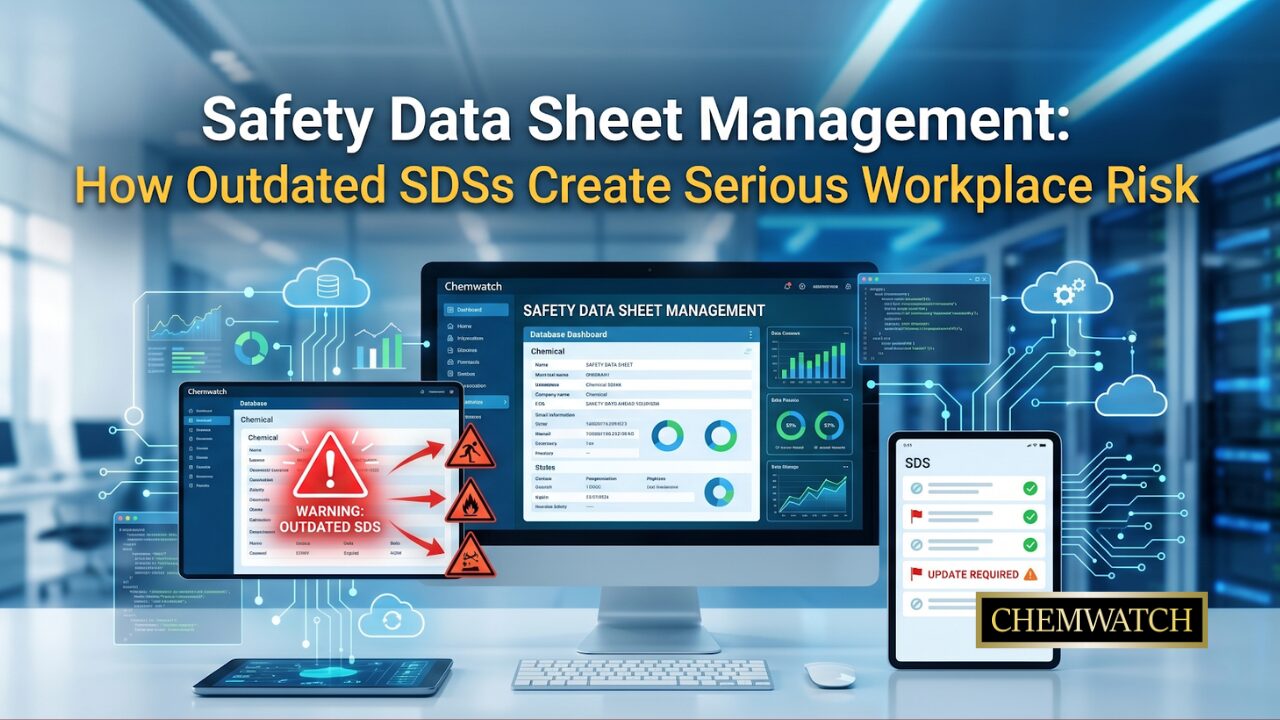
Every day, workers handle many hazardous chemicals; from industrial solvents and cleaning agents to pesticides and laboratory reagents. Behind each product sits a document that can mean the difference between a minor incident and a life-altering event: the Safety Data Sheet (SDS). Yet despite their importance, many SDS libraries are poorly maintained and, most dangerously, allowed to become outdated. The result is a preventable gap in workplace chemical safety and a growing threat to chemical safety compliance.

A Safety Data Sheet is a standardised document providing comprehensive information about a hazardous substance or mixture.
A Safety Data Sheet is a standardised document providing comprehensive information about a hazardous substance or mixture. Under GHS-aligned frameworks and local regulations, an SDS follows a 16-section format covering everything from identification and hazards to first aid, firefighting measures, exposure controls/PPE, toxicology, and regulatory information.
In practice, SDSs are a frontline control for chemical safety compliance because they:
This is why robust Safety Data Sheet management isn’t administrative overhead; its core safety infrastructure.
Chemical risk information doesn’t stand still. Formulations change, classifications are updated, exposure limits shift, and new toxicological evidence emerges. An SDS that was correct five years ago may now contain:
When teams rely on a stale document, decisions are made on the wrong assumptions. These outdated SDS risks can include:
Regulators commonly expect SDSs to be reviewed and updated at least every five years, or immediately when new hazard information becomes available. Many workplaces fall short, often without realising the compliance debt they’re carrying.
The consequences of poor Safety Data Sheet management are not theoretical. There are documented cases where inaccurate or outdated hazard communication contributed to serious harm:
These examples underline a simple point: workplace chemical safety depends on current information, not best guesses.
Beyond the human cost, outdated SDS libraries create hard business risk:
For organisations managing hundreds or thousands of products, manual updating is rarely sustainable. This is where SDS compliance software and automated SDS management move from “nice to have” to necessity.
Modern SDS compliance software reduces the single greatest weakness in hazard communication: the lag between a change (new classification, reformulation, regulatory update) and that change reaching the shop floor.
With automated SDS management, organisations can:
Chemwatch provides an end-to-end platform for Safety Data Sheet management designed to keep pace with regulatory and supplier changes. The Chemwatch system supports automated SDS management by continuously updating SDS libraries, flagging changes, supporting regulatory monitoring across jurisdictions, and enabling audit-ready reporting. It also supports risk assessment workflows, label generation, and emergency response access, helping organisations maintain consistent workplace chemical safety and stronger chemical safety compliance at scale.
An SDS is only protective if it’s accurate. A document filed away and forgotten isn’t a safety measure, it’s a liability. Strong Safety Data Sheet management, backed by SDS compliance software and automated SDS management, closes the gap between changing hazard information and real-world workplace decisions. In chemical safety, “up to date” isn’t a nice-to-have, it’s the minimum standard.
Resources