
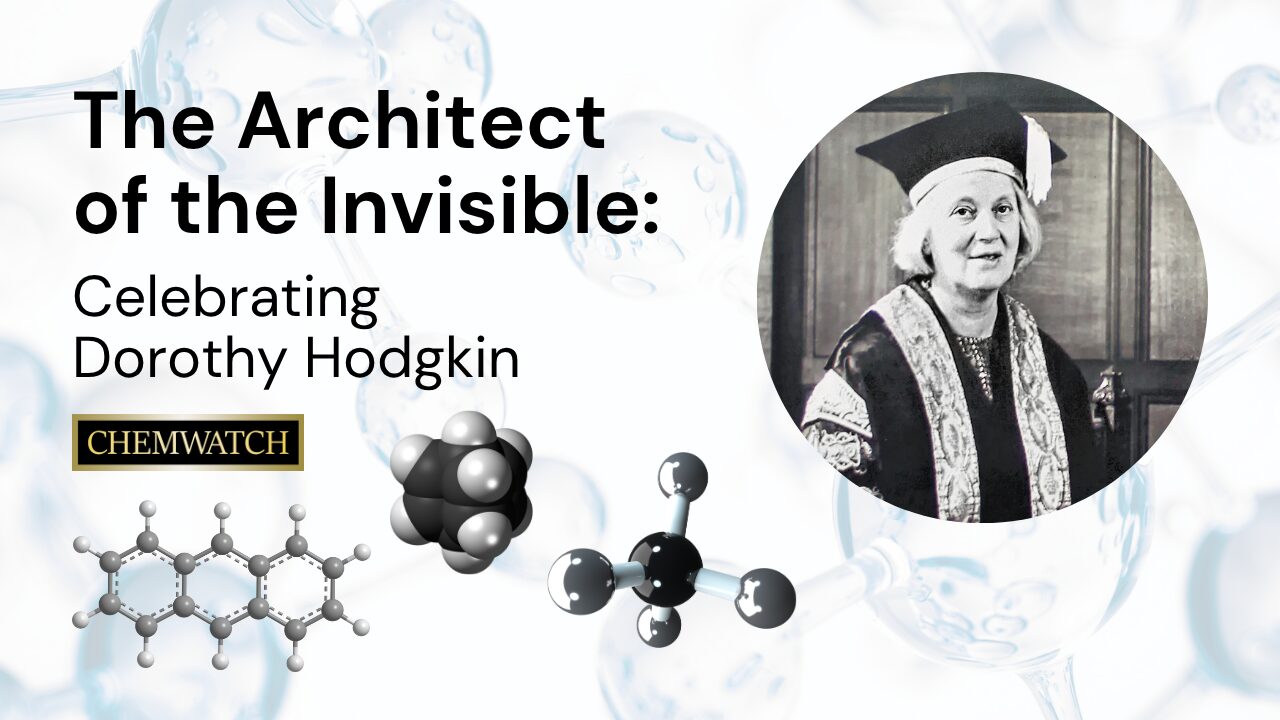
This month, we celebrate the life and legacy of Dorothy Crowfoot Hodgkin, a titan of 20th-century science and the third woman ever awarded the Nobel Prize in Chemistry. At a time when the inner workings of complex biological molecules were largely unknown, Hodgkin gave the scientific world the tools to actually see them. Her breakthroughs didn’t just solve chemical puzzles, they reshaped medicine, accelerated drug development, and helped build the foundations of modern structural biology.
Hodgkin is best known for pioneering and advancing X-ray crystallography, transforming it from a specialist technique into one of the most powerful methods for understanding molecular structure.
The principle is elegant. Scientists direct a focused beam of X-rays at a crystallised sample, anything from salts and minerals to proteins and pharmaceuticals. As the X-rays hit the atoms inside the crystal, they scatter in distinct patterns. By measuring those patterns, researchers can work backwards using mathematical analysis to map the precise three-dimensional arrangement of atoms.
In other words, crystallography reveals a molecule’s “shape blueprint,”and that shape determines how it behaves in the body, how it binds to targets, and how it can be optimised for therapeutic use.
Throughout her career, Hodgkin focused on molecules with real human impact. Her work wasn't just theoretical; it was a roadmap for medical breakthroughs. Some of her most significant "structural reveals" included:
Hodgkin’s extraordinary contributions to structural chemistry earned her the Nobel Prize in Chemistry in 1964. She remains the only British woman to have won a Nobel Prize in a science category.
But her impact didn’t stop at the laboratory door. Hodgkin was also a committed advocate for peace and scientific responsibility, including serving as president of the Pugwash Conferences on Science and World Affairs. Her career modelled a powerful idea: that scientific excellence and social conscience can, and should, coexist.
X-ray crystallography remains a critical tool across research, pharmaceuticals, materials science, and chemical safety. It continues to help scientists:
Hodgkin didn’t just study chemistry, she helped build the toolkit that lets us actually see chemistry. Her work proved that persistence, rigour, and curiosity can bring the hidden architecture of life into the light.
At Chemwatch, we recognise that breakthroughs like Hodgkin’s are not only milestones in science, they are foundations for safer decision-making across industries. Structural chemistry supports everything from drug development to toxicology and hazard understanding, strengthening the evidence that informs safer handling, classification, and communication. As the chemistry behind products and processes grows more complex, the ability to understand what molecules are and how they behave remains central to responsible chemical management.
Resources